AI Strategy7 min read
How Mid-Market Companies Are Cutting Costs by 30%+ with AI
Key takeaways
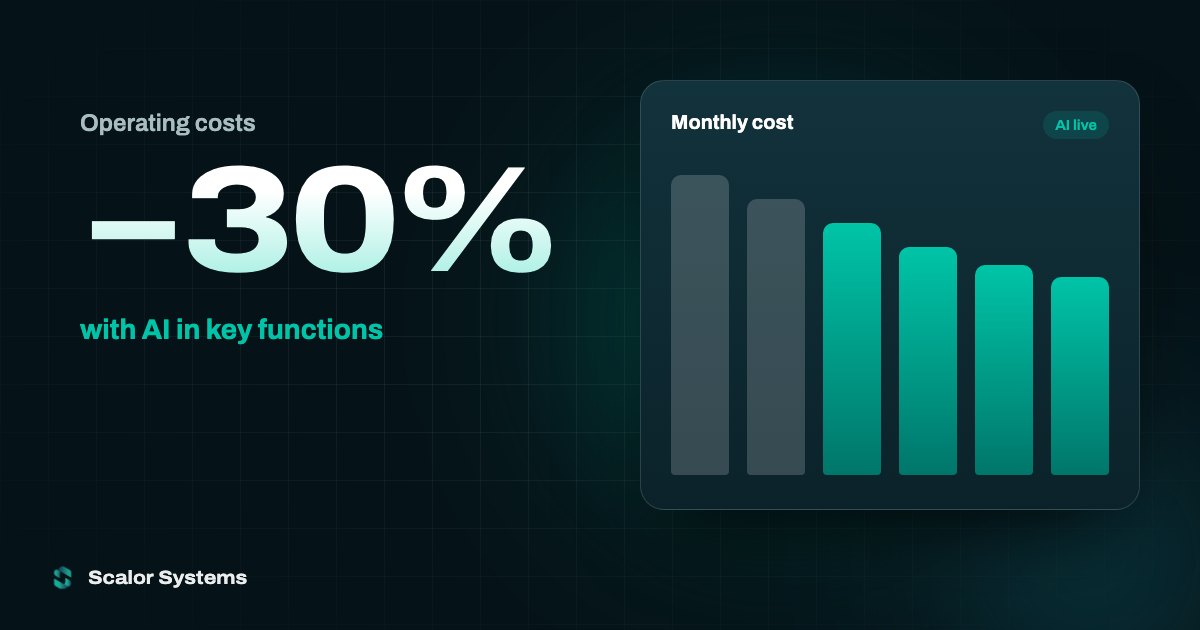
- Companies that start from a specific, measurable business problem see AI cost reductions of 25–40% in key functions.
- Customer support, document processing and predictive operations deliver the most consistent savings.
- Measure the current cost first, prove savings on one workflow, then expand.
Companies that integrated AI into their operations over the past 18 months are seeing cost reductions of 25–40% across key functions. Here’s what they did differently, and what it actually took to get there.
The companies seeing results have one thing in common
In our work with 50+ mid-market companies across the GCC, we’ve seen a clear pattern: companies that achieve meaningful cost savings from AI don’t start with the technology. They start with a specific, measurable business problem, such as a cost line, a backlog or a delay, and work backwards to the tool.
The companies that struggle treat AI as a strategy in itself. They hire AI consultants, build AI roadmaps, and run AI pilots. Then 18 months later, they have a lot of learnings and very little return.
Three functions where cost reduction is most consistent
Based on our client work, the most reliable AI cost savings come from three operational areas: customer support, document processing and predictive operations. They share three traits: high volume, repetitive decisions, and a clear “before” cost you can measure against.
1. Customer support automation (avg. 35% cost reduction)
AI-powered customer support doesn’t mean removing people. It means sending routine questions to automation and letting your team handle the cases that need judgment. Companies that implement this well typically see 60–80% of tier-1 queries handled automatically, around a 35% reduction in support costs, and faster resolution times that improve customer satisfaction.
In the GCC, the channel matters as much as the model. Most customers message on WhatsApp, often switching between Arabic and English in the same conversation. A support agent that handles both languages natively on WhatsApp beats a polished English-only web chatbot every time.
2. Document processing (avg. 45% cost reduction)
For companies in financial services, legal, real estate, logistics and healthcare, documents are the bottleneck. Invoices, contracts, delivery notes and ID documents arrive as PDFs and scans, and someone re-types them into a system. AI-powered extraction, checking and routing removes entire categories of that manual work.
The savings here are often the fastest to realise. The “before” cost is easy to measure in hours per document, and some clients see a return within six weeks.
3. Predictive operations
Forecasting demand, stock levels, equipment failures or cash flow from your own historical data lets you plan instead of react. The savings show up as less over-stock, fewer emergency repairs and better staffing. They take a little longer to prove, but they compound.
What the successful projects did differently
- They measured the current cost of the process before building anything.
- They picked one workflow, proved the savings, then expanded.
- They integrated AI into existing tools instead of adding a new one for staff to learn.
- They assigned an owner to keep the system accurate after launch.
What to do next
The best place to start is an AI Architecture Audit: a structured review of your operations that finds where AI will produce real savings in your specific business. That’s exactly how Scalor Systems starts with most clients.