Saudi Market5 min read
AI Cybersecurity Guidelines Saudi Arabia: What to Do
Key takeaways
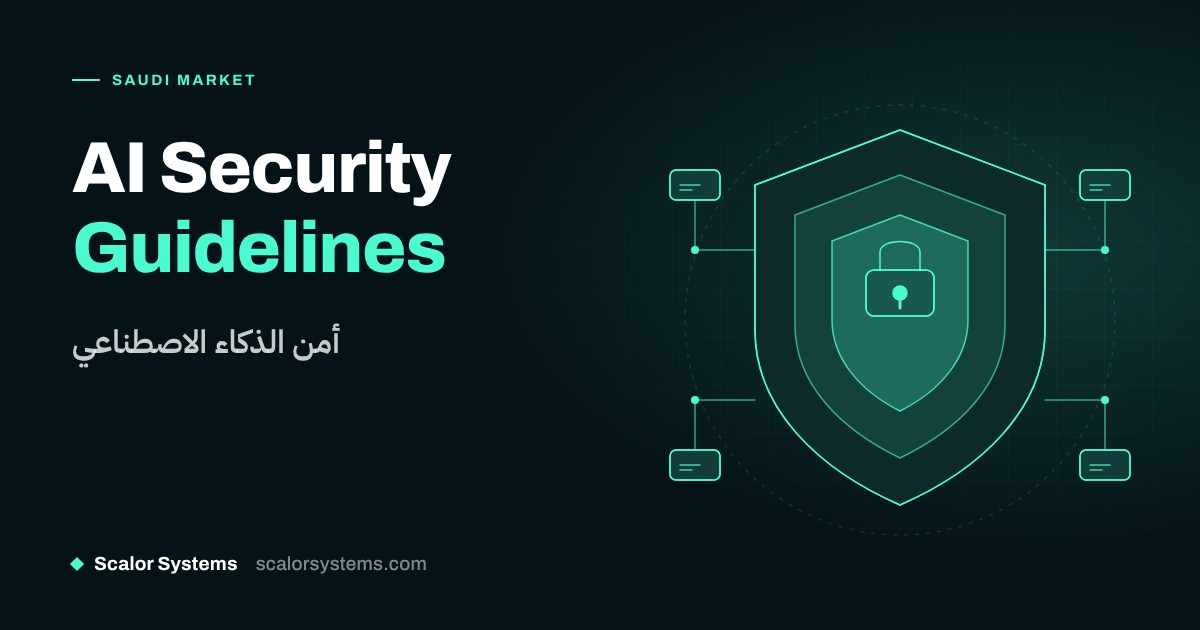
- Saudi Arabia’s National Cybersecurity Authority (NCA) ran a public consultation on draft AI Cybersecurity Guidelines from 5 July to 5 August 2026. The draft covers generative and agentic AI and is aimed at entities that use or plan to adopt AI.
- It is organized in four domains: governance, defense, resilience and third-party cybersecurity. We found no final version at the time of writing, and sources disagree on whether it will be binding, so treat it as a preview of what buyers and auditors will ask.
- You can prepare now: list every AI tool in use, name an owner for each, record what data it touches, and add AI-specific questions to your supplier checks.
The AI cybersecurity guidelines Saudi Arabia’s National Cybersecurity Authority (NCA) has drafted matter to any company that uses a chatbot, an AI assistant or an automated agent, even a small one. The draft sets out how AI systems should be governed, defended and recovered when something goes wrong. This guide is written for owners and managers in Dammam, Khobar, Riyadh and Jeddah who want to know what the draft says, what is still uncertain, and what to do now. It is a business briefing, not legal advice.
AI cybersecurity guidelines Saudi Arabia: what the NCA published
According to the NCA’s announcement dated 5 July 2026, the authority opened a public consultation on draft “AI Cybersecurity Guidelines”, with feedback due by 5 August 2026. The stated aim is to make sure AI cybersecurity requirements are implemented and to reduce the cyber risks that come with AI technologies and systems. The NCA says the document was developed using international best practice.
The scope covers emerging technologies, including generative AI and agentic AI, meaning systems that can take actions on their own. The NCA says the guidelines are aimed at entities in the Kingdom that already use AI or plan to adopt it. Comments were collected through the government’s Istitlaa platform. The NCA’s consultation page lists the consultation as closed.
The four domains of the draft guidelines
The NCA says the draft rests on four primary domains, each with sub-domains. Noqta, a technology news site, summarizes what each is likely to mean in practice. These readings come from that article, not from the NCA text, so check them against the final document.
- Governance: who owns each AI system, what data goes into it, and how its decisions are logged and reviewed.
- Defense: protecting models, data and access points from threats such as prompt injection, where a hostile instruction is hidden in the text an AI reads.
- Resilience: detecting, containing and recovering from an AI-related incident.
- Third-party cybersecurity: the risks that come from outside suppliers, such as AI models, plug-ins and the tools an agent connects to.
Is it mandatory? Sources disagree
Digital Policy Alert, which tracks digital regulation, describes the draft as setting out non-binding recommendations. ValueMentor, a cybersecurity consultancy, expects it to become a mandatory overlay on existing NCA controls, but its author presents that as his own inference, not an NCA statement. Both articles say the document was still a draft after the consultation closed, and we found no final publication.
The practical reading is simple. Whether or not the final text is binding, large customers, banks and government bodies often pass such expectations down to their suppliers. If you sell to them, expect questions about how you manage AI risk.
How it fits with rules you may already follow
The draft does not start from nothing. ValueMentor notes that its four domains mirror the structure of the NCA’s Essential Cybersecurity Controls (ECC-2:2024), and that a separate NCA instrument, NCNICC-1:2025, took effect in January 2026 and extends mandatory controls to some private-sector companies. We have not verified those details against the NCA texts, so ask your IT or security adviser which controls apply to your business.
If a control set already applies to you, the sensible move is to add your AI tools to the same register, the same access reviews and the same incident plan, rather than build a separate process. That carries your existing evidence forward and keeps the effort small for a mid-sized team.
Agentic AI changes the risk
A chatbot that only answers questions can leak information. An agent that can send messages, update records or approve requests can also cause damage by acting on a wrong or manipulated instruction. ValueMentor argues that agents should be treated as a separate risk category, with clear limits on what each can access and points where a person must approve. That is sound practice whatever the final text says. For examples of where agents are used in operations, read our post on AI agents in operations.
A six-step AI cybersecurity check you can start this week
- List every AI tool in use, including ones staff signed up for themselves, and who owns each.
- Record what data each tool receives and where it is processed and stored. Our post on PDPL cross-border data transfer explains why this matters for personal data.
- Give each tool the least access it needs. An assistant that answers customers should not be able to edit your accounts.
- Decide which actions need human approval, such as payments, refunds or changes to customer records.
- Keep logs of what each tool did, so you can investigate and show an auditor or client.
- Add AI questions to your supplier checks: where data goes, how updates are handled, and who responds to an incident.
Where to start
Most companies cannot answer these questions because their AI tools were added one at a time. Our AI Architecture Audit maps what you run, what data it touches and where the gaps are. Our AI Integration service connects tools to your systems with limited access and logging, and our AI knowledge assistant solution keeps answers grounded in your own documents. To discuss your own case, book a free discovery call with Scalor Systems at scalorsystems.com/contact.
Sources
- National Cybersecurity Authority: NCA Launches Public Consultation on “AI Cybersecurity Guidelines” (5 July 2026)
- National Cybersecurity Authority: Public consultations page (AI Cybersecurity Guidelines, closed; updated 20 August 2026)
- Digital Policy Alert: Saudi Arabia, AI Cybersecurity Guidelines (AICG-1: 2026)
- Noqta: Saudi NCA Closes Consultation on AI Cybersecurity Guidelines (11 August 2026)
- ValueMentor: From Generative AI to Agentic AI, What Saudi Arabia’s Emerging AI Cybersecurity Guidance Means for Enterprise Governance (4 September 2026)