AI Strategy5 min read
AI in Procurement Saudi Arabia: Where Buyers Start
Key takeaways
- GASTAT reports that 33.1% of Saudi establishments used AI technologies in 2025, up 20.0% on 2024, so purchasing teams are working in a market where AI is already common.
- In Gartner surveys run in April 2026, 63% of procurement leaders expected AI to significantly improve procurement performance within three years, but only 25% had redesigned jobs and roles because of AI.
- Start with one measurable task, such as matching invoices to purchase orders or comparing supplier quotes, clean your supplier list first, and keep every decision that commits money with a person.
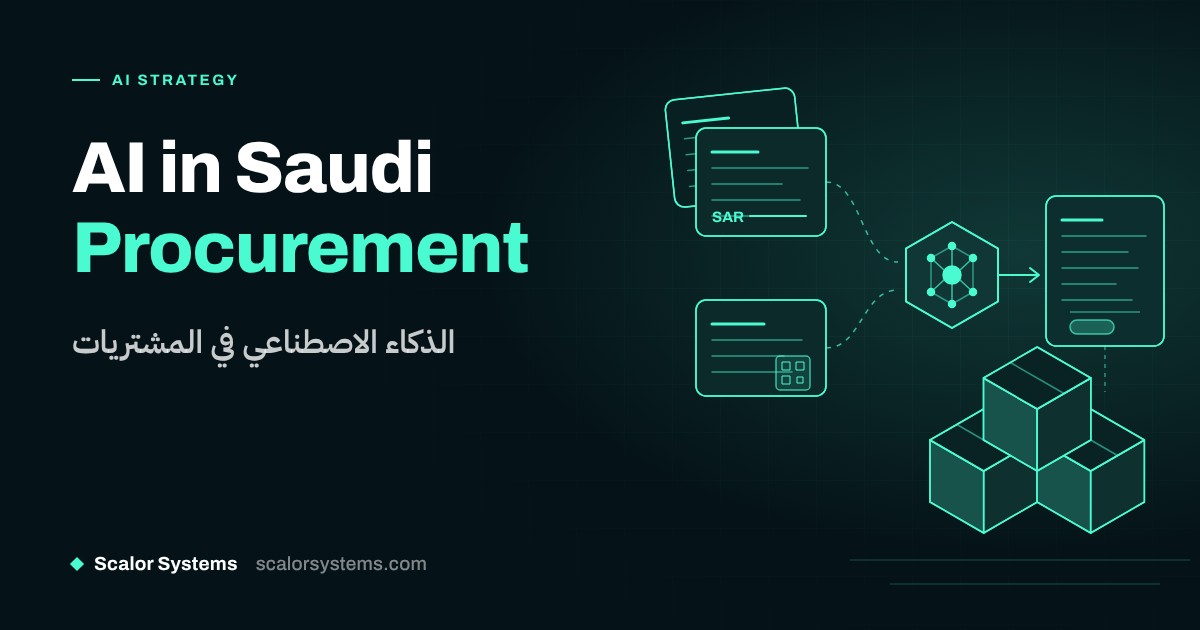
AI in procurement in Saudi Arabia is one of the most practical places for a company to start with AI, because purchasing runs on documents, approvals and repeat decisions. Quotes arrive as PDFs, emails and WhatsApp messages. Purchase orders are re-typed into the ERP, and supplier invoices are checked against orders by hand. If you run a logistics, healthcare, real estate, retail, education or facilities business in Dammam, Khobar, Riyadh or Jeddah, your buyers probably spend more time chasing paperwork than negotiating. This guide is written for decision-makers, not developers. It covers what recent data says, the purchasing tasks AI handles well, and a six-step plan to start.
Why AI in procurement matters for Saudi companies now
Saudi businesses are already using AI. In its Establishments ICT Access and Usage Statistics 2025, the General Authority for Statistics (GASTAT) reports that 33.1% of establishments used AI technologies in 2025, growth of 20.0% compared with 2024. Transportation and storage stood at 44.4%, and wholesale and retail trade at 30.2%.
The same survey shows how digital the back office already is. GASTAT found that 93.2% of establishments used e-government services and 79.1% used the internet for electronic banking. In other words, most of the data your buyers need is already digital. What is usually missing is the link between the email, the quote, the ERP and the invoice, and that is where AI earns its place.
What procurement leaders expect from AI
Gartner surveyed senior procurement leaders in April 2026. According to Consumer Goods Technology’s report of the findings on 14 October 2026, 63% of procurement leaders expect AI to significantly improve procurement performance over the next three years, but only 25% have redesigned jobs and roles because of AI. The figures come from the 2026 Gartner Chief Procurement Officer Survey of 213 senior procurement leaders and the 2026 Gartner C-Suite AI Survey, which included 134 procurement leaders.
Gartner advises procurement chiefs to audit which tasks stay with people and which can move to AI, to build human skills such as influence and ethical judgement, and to give staff a safe space to test AI tools. Gartner senior director analyst Fareen Mehrzai warned that leaders who delay redesigning roles “risk leaving employees without a clear path forward”. A mid-sized Saudi company may not have a chief procurement officer, but the lesson holds: decide who does what before you buy a tool.
Five purchasing tasks AI handles well
These are our recommendations from the purchasing work we see, not findings from the surveys above.
- Reading and comparing supplier quotes. AI pulls price, delivery time, payment terms and validity out of PDF and emailed quotes and lays them side by side, so the buyer compares like with like.
- Drafting purchase orders. Approved requests become draft purchase orders in your ERP with the right supplier, item codes and cost centre, ready for a person to approve.
- Matching invoices to orders and receipts. AI checks each supplier invoice against the purchase order and the goods received note, and sends only the mismatches to a person.
- Tracking supplier documents. Commercial registration, VAT certificates, insurance and contract end dates are tracked, with an alert before anything expires.
- Spend reporting. A weekly summary shows spend by supplier, category and branch, and flags price rises, duplicate suppliers and orders placed outside agreed contracts.
How ZATCA e-invoicing helps purchase-to-pay automation
ZATCA defines an electronic invoice as a tax invoice in a structured electronic format, and says scanned or copied paper invoices do not count. Phase One, the generation phase, has applied since 4 December 2021. Phase Two, which requires integration with ZATCA’s systems, has been rolled out in waves since 1 January 2023.
For a buyer, this matters because more supplier invoices now start life as structured data rather than a picture of paper. Where a supplier can send you the structured invoice, matching it to an order is more reliable than reading a scan. Ask your larger suppliers what they can send, and keep a document-reading route for the rest. Our earlier post, AI Invoice Processing and ZATCA E-Invoicing: What Saudi SMEs Should Know, covers the finance side in more detail.
AI procurement checklist: six steps to start
- Map your purchase-to-pay process. Write down each step from request to payment, who does it and which system it uses.
- Count the manual work. For two weeks, record how many quotes, purchase orders and invoices the team handles, and how long each one takes.
- Clean your supplier list. Remove duplicates and fill in VAT numbers, payment terms and contacts, because AI matching is only as good as this list.
- Pick one task with a clear number. Invoice matching and quote comparison are good first choices because time and errors are easy to measure.
- Set approval limits. Decide which amounts and exceptions always need a person, and write them down before any tool goes live.
- Measure for 90 days, then decide. Compare handling time, error rates and late payments before and after, and only then move to the next task.
What should stay with your buyers
AI should not choose suppliers or sign contracts. Negotiation, relationships with key suppliers, judgement on quality and any decision that commits money belong with people. Supplier contact names, phone numbers and email addresses are personal data, so confirm where any AI tool stores them and check that against your obligations under the Personal Data Protection Law (PDPL).
If you also sell to government entities, the supplier-side rules have changed too. See our post Saudi Government Procurement Law 2026: Supplier Checklist.
How Scalor Systems can help
Our document processing and workflow automation solution reads quotes, delivery notes and invoices into your ERP, and our AI dashboards and reporting solution gives managers a weekly view of spend by supplier and branch. Our AI Integration service connects both to the systems you already run, such as your ERP, email and approval workflow. To find the first purchasing task worth automating, book a free discovery call with Scalor Systems at scalorsystems.com/contact.