Saudi Market5 min read
AI Risk Management Framework Saudi Arabia: Next Steps
Key takeaways
- SDAIA launched a national AI risk management framework on 14 July 2026. It gives government and private organisations one method to identify, assess, treat and monitor AI risks.
- The framework follows four phases and rates each risk by combining how likely it is with how large the impact would be. Gowling WLG says it applies to organisations of any sector or size and focuses on high-impact systems.
- Sources describe it as a governance tool and do not describe enforcement, but a simple AI register and a written risk review are sensible steps for any firm using AI on customer data.
The AI risk management framework Saudi Arabia introduced this year gives companies a shared way to ask a simple question: what could go wrong with this AI tool, and how bad would it be? The Saudi Data and AI Authority (SDAIA) launched the National AI Risk Management Framework in July 2026. This guide is written for owners and managers in Dammam, Khobar, Riyadh and Jeddah who use, or plan to use, AI in daily operations. It is a business briefing, not legal advice.
AI risk management framework Saudi Arabia: what SDAIA launched
According to a Saudi Press Agency report from Riyadh dated 14 July 2026, SDAIA launched a national AI risk management framework. It provides a unified national methodology for identifying, assessing, treating and monitoring AI risks, with the aim of helping public and private entities adopt AI safely and responsibly.
SDAIA noted that AI risks differ from traditional software risks. They may emerge unexpectedly, change over time and prove difficult to explain or reproduce, so they need an integrated approach. The framework is built on seven core principles, including integrity, privacy, transparency and accountability, and it sorts AI risks into seven main types.
One detail on dates: law firm Gowling WLG, writing on 22 July 2026, says SDAIA published the framework document in April 2026. The public launch reported by SPA came in July.
Who it applies to
Gowling WLG says the framework applies to government and private organisations in the Kingdom, whatever their sector or level of digital maturity. It focuses on high-impact systems, such as predictive models, natural language processing, image and video analysis, intelligent automation and general-purpose models like large language models. A WhatsApp assistant, an invoice reader or a demand forecast could all fall into those groups.
Gowling describes it as a governance and risk management tool, not a technical standard. It does not set performance benchmarks or model-testing rules. The sources we reviewed do not describe enforcement or penalties, so ask your legal adviser how it applies to your sector, particularly if you serve government bodies or work in health or finance.
The four phases in plain language
SPA lists four connected phases. Here is what each means for a small or mid-sized firm.
Phase one is defining context and scope. Write down what the AI tool does, what data goes in, what comes out and who checks it. Phase two is identifying and assessing risks. Gowling says the framework groups risks into seven categories: bias and harm, privacy and security, misinformation, harmful use, human-machine interaction, socioeconomic and environmental impact, and safety and limitations.
Phase three is treating risks. The options are to avoid the risk, reduce it, transfer it, for example through a contract or insurance, or accept it when what remains is within your approved tolerance. Phase four is continuous monitoring and review, so a tool is checked again as it changes.
How risk is scored
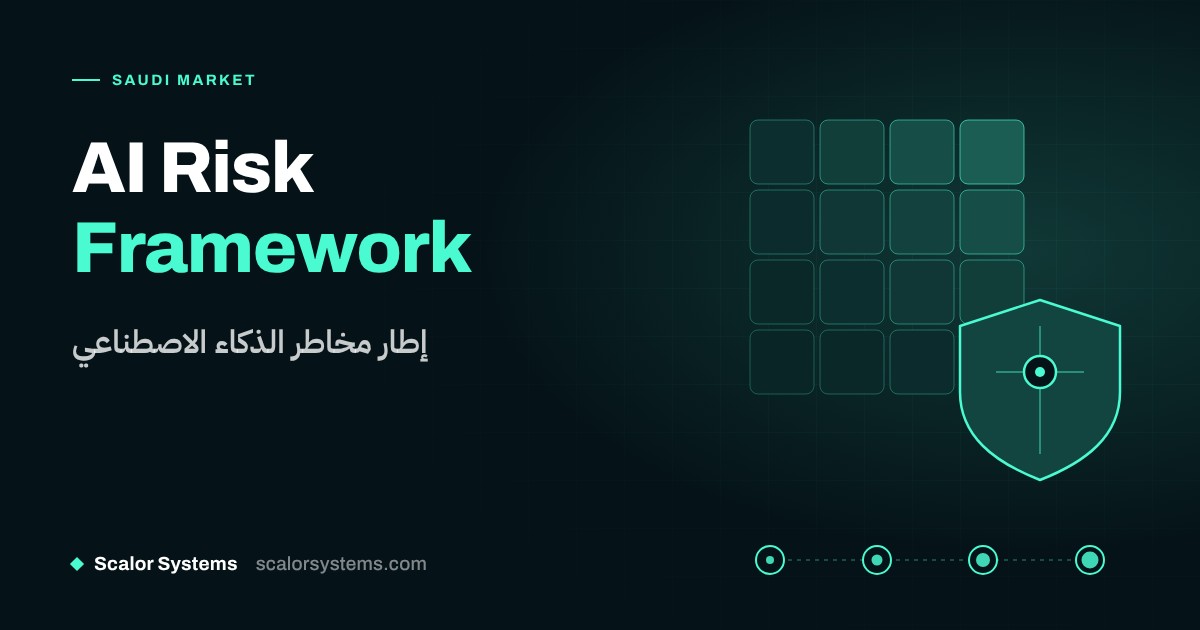
SPA says risk levels come from a matrix that links the probability of a risk with the scale of its impact. Gowling gives the detail: four likelihood levels, from rare (under 1% a year) to near-certain (50% or more), and four impact levels, from low to catastrophic. Likelihood multiplied by impact gives a score from 1 to 16, from low through medium and high to catastrophic.
You do not need that exact scale to benefit. Even a simple low, medium and high rating, agreed in writing, makes it easier to decide which AI tools need a human check and which can run on their own.
Why it matters for ordinary businesses
Fast Company Middle East, reporting on 30 September 2026, linked the framework to companies deploying more autonomous AI systems, which raises questions about data access, automated decisions and human oversight. A chatbot that answers customers or a tool that approves invoices is making decisions on your behalf. This framework gives you a way to show you thought about the downside first.
It also fits with rules you may already follow. Our post on the SDAIA AI Adoption Framework checklist covers the governance baseline, and the PDPL still governs personal data. The risk framework adds a repeatable method on top.
A five-step AI risk review
- Build an AI register. List every AI tool in use, including free tools staff use themselves, with its purpose, the data it sees and an owner.
- Rate each tool for impact. Ask what happens if it is wrong, biased, leaks data or is misused, and mark it low, medium or high.
- Decide the treatment. For each medium or high risk, choose to avoid it, reduce it with a human check, transfer it through a contract, or accept it in writing.
- Name an approver. Someone senior should approve, approve with conditions, limit or stop each higher-risk tool.
- Review on a schedule. Re-check every tool at least once a year and whenever the supplier, data or use changes.
How Scalor Systems can help
Most firms find step one the hardest, because AI tools sit across many systems. Our AI Architecture Audit maps every AI tool and data flow and gives you a ranked list of risks to treat. Our AI Integration service adds the human-approval steps to the tools you keep, and our AI Knowledge Assistant solution can give staff a trusted place to find your own AI policy. To discuss your own risk review, book a free discovery call with Scalor Systems at scalorsystems.com/contact.
Sources
- Saudi Press Agency: SDAIA Introduces National Framework for Managing AI Risks (14 July 2026)
- Gowling WLG via Mondaq: What Saudi Arabia’s AI Risk Management Framework Means For Organisations (22 July 2026)
- Fast Company Middle East: Saudi Arabia launches national framework for AI risk management (30 September 2026)
- Middle East AI News: Saudi Arabia launches national AI risk framework (14 July 2026)