Saudi Market5 min read
Financial Professions Saudization: 50% From May 2027
Key takeaways
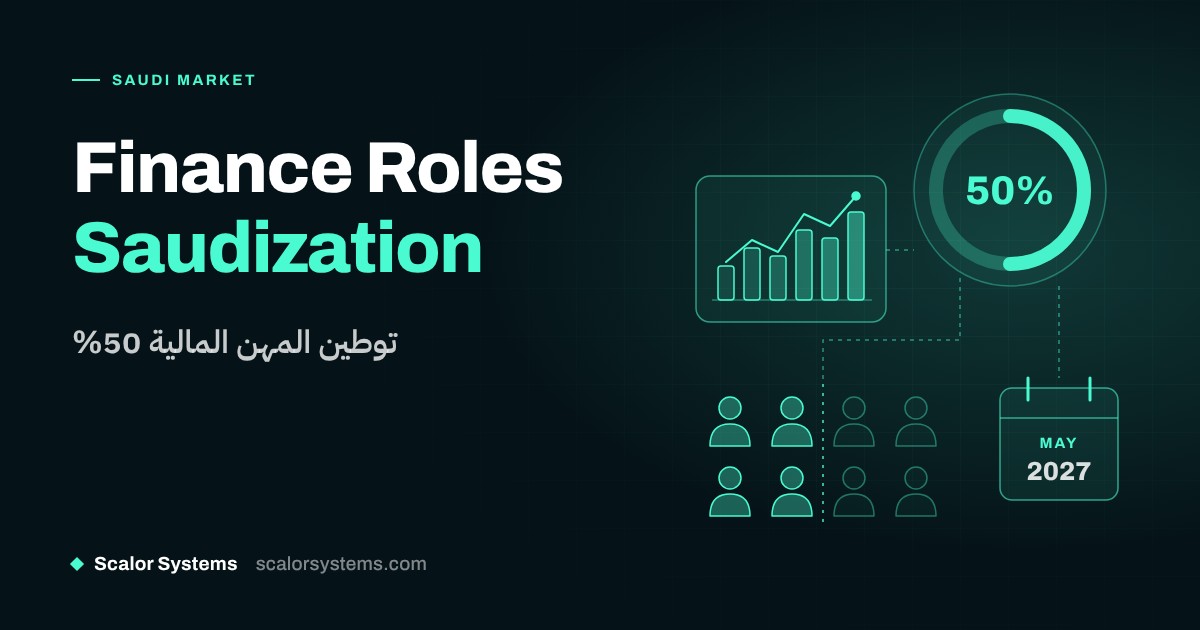
- On 22 November 2026, the Ministry of Human Resources and Social Development (HRSD) and SOCPA announced 50% Saudization of 17 financial professions in the private sector, effective 23 May 2027.
- The rule applies to private establishments with two or more workers in the targeted roles, from financial analysts and treasury specialists to credit managers and investment advisers. Covered firms get a six-month grace period.
- Use the grace period to map job titles, count covered staff across the company and plan hiring, with the Nitaqat salary threshold rising to SAR 5,000 on 25 April 2027 in mind.
Financial professions Saudization is the newest localization rule for Saudi employers. On 22 November 2026, the Ministry of Human Resources and Social Development (HRSD), in partnership with the Saudi Organization for Chartered and Professional Accountants (SOCPA), announced that 50% of jobs in 17 financial professions in the private sector must be held by Saudis from 23 May 2027. If you run a company in Dammam, Khobar, Riyadh or Jeddah with analysts, treasury staff or credit managers on the payroll, this guide is written for decision-makers, not developers. It covers what was announced, who is covered, what is still unclear and a six-step plan for the grace period. It is a business briefing, not legal advice.
What HRSD announced on 22 November 2026
According to HRSD’s announcement, the decision localizes financial professions in the private sector at a rate of 50%, starting 23 May 2027. The stated aim is to create quality jobs for Saudi men and women across the Kingdom and raise their participation in the labour market. Gulf News, and Riyadh Daily in a Saudi Press Agency report, gave the same rate, start date and scope.
Covered establishments get a six-month grace period from the launch of the decision before it takes effect, so they can prepare and reach the required rate. HRSD urged them to read the accompanying procedural guide, which sets out the targeted professions, the rates and how they are calculated, to avoid penalties for non-compliance.
Who financial professions Saudization covers
The rule applies to private-sector establishments that employ two or more workers in the targeted professions, according to the definitions, job titles and conditions in the procedural guide. That threshold is low. A mid-sized trading, logistics or real estate company with one financial analyst and one treasury specialist is already inside it.
HRSD lists 17 professions:
- Analysis and planning: financial analysis specialist, financial planning specialist, financial control specialist, financial investigator.
- Advice: financial consulting specialist, financial adviser, financial expert.
- Investment: investment manager, investment specialist, investment adviser, investment expert.
- Treasury, credit and products: treasury specialist, credit manager, financial product development specialist.
- Oversight and other roles: financial services control manager, financial brokerage manager, government revenue specialist.
The grouping above is ours, for readability. The official titles and their definitions are in HRSD’s procedural guide.
How it fits with other Saudization rules
This is a separate decision from the accounting Saudization rule, which covers accounting professions and uses a different headcount threshold. A finance department may contain roles under both, so check each person’s title against the right list. Our post Accounting Saudization 50%: What Finance Teams Do Now explains the accounting rule.
Pay matters too. Saudi Arabia announced on 25 October 2026 that, from 25 April 2027, a Saudi employee must earn at least SAR 5,000 a month to count as one full worker under Nitaqat, rising to SAR 6,000 on 25 April 2028, as Gulf News reported. That first step lands about four weeks before the financial professions rule starts, so salary and headcount plans should be made together.
What is still unclear
At the time of writing we could not open the procedural guide for this decision. Several practical details therefore remain open: how the rate is rounded, whether any minimum wage applies specifically to these roles, whether any type of establishment is excluded, and how penalties will be applied. Read the guide on HRSD’s website before you make hiring or restructuring decisions, and ask your HR adviser where your case is borderline.
Financial professions Saudization: a six-step plan for the grace period
These are our recommendations, not requirements from the decision itself.
- Map real duties to official titles. List everyone who does financial analysis, treasury, credit, investment or advisory work, whatever their contract says, and match each person to one of the 17 titles.
- Count across the whole company. Check whether you have two or more people in the targeted professions, and how many Saudis among them meet the rule’s conditions.
- Work out the gap now. Compare your current Saudi share with 50% and note how many hires, transfers or promotions would close it by 23 May 2027.
- Line up pay with April 2027. Check each Saudi employee’s salary against the SAR 5,000 Nitaqat threshold that applies from 25 April 2027.
- Use the support on offer. HRSD says its package includes nominating Saudi candidates, training and qualification, employment and retention support, and priority access to localization programmes.
- Build a simple tracker. Keep titles, nationality, salary and start dates in one live report, so you can see the rate change with every hire or departure.
Where AI fits, and where it does not
No software changes a Saudization rate. The rule counts people in covered roles, and an AI model that drafts a forecast is not an employee. What technology can do is make compliance visible and help new team members get productive faster.
A live HR and finance dashboard can show covered roles, the Saudi share and salary levels in one view, so a gap appears months before the deadline rather than during an inspection. An internal knowledge assistant can answer new analysts’ questions about your credit policy, treasury procedures and reporting calendar from your own documents, which helps when several Saudi graduates join at once.
How Scalor Systems can help
Our AI Dashboards and Business Intelligence solution can turn payroll and HR data into a live Saudization view by role, and our AI Knowledge Assistant solution helps new finance staff find answers in your policies and procedures. Our AI Integration service connects both to the HR and accounting systems you already use. To plan your finance team for May 2027, book a free discovery call with Scalor Systems at scalorsystems.com/contact.
Sources
- Ministry of Human Resources and Social Development: HRSD and SOCPA announce 50% localization of 17 financial professions (22 November 2026, Arabic)
- Gulf News: Saudi Arabia to mandate 50% Saudisation in 17 financial professions by May 2027 (22 November 2026)
- Riyadh Daily (SPA): Saudization decision for 17 financial professions takes effect May 2027 (23 November 2026)
- Gulf News: Saudi Arabia raises minimum wage thresholds to SR5,000 in 2027 and SR6,000 in 2028 (26 October 2026)