AI Strategy5 min read
AI Data Readiness Saudi Arabia: Fix Your Data First
Key takeaways
- Gartner predicts that through 2026 organizations will abandon 60% of AI projects that are not supported by AI-ready data. Its July 2024 survey of 1,203 data management leaders found 63% either lack the right data management practices for AI or are unsure they have them.
- GASTAT data reported by Arab News shows 33.1% of Saudi establishments used AI in 2025. As more firms start, the gap between a good pilot and a working system is often the data underneath it.
- Before you buy any AI tool, pick one use case, find where its data lives, fix the few fields it needs, name an owner and check consent. A small clean dataset beats a big messy one.
AI data readiness Saudi Arabia is the question that decides whether your next AI project works or quietly stalls. Many owners start by choosing a tool. The better start is a look at the data the tool will read: customer records, invoices, delivery notes, patient files, price lists. This guide is written for owners and managers in Dammam, Khobar, Riyadh and Jeddah in logistics, healthcare, real estate, retail, education and facilities. It sets out what Gartner and Saudi data say, and gives a six-step plan to get one use case ready.
Why AI data readiness in Saudi Arabia matters now
Saudi businesses are moving. The General Authority for Statistics (GASTAT) reports that 33.1% of Saudi establishments used AI in 2025, according to Arab News on 14 June 2026. By sector, the report put information and communications at 61.1%, finance and insurance at 52.9%, education at 51.0%, and transport and storage at 44.4%. Two in three establishments had not started. That is room to learn from early movers, and one lesson is that the tool is rarely the hard part.
Snowflake showed how seriously the market treats data. In an announcement reported by Zawya on 27 October 2026, the company said it projects a $300 million (about SAR 1.125 billion) investment in Saudi Arabia through 2030, with a regional headquarters in Riyadh and two more Saudi cloud regions planned for the second half of 2026 alongside its existing Google Cloud region in Dammam. Snowflake says the figure rests on an independent IDC analysis that it commissioned, so treat it as a vendor projection. It also plans, with the Ministry of Communications and Information Technology, to train up to 25,000 learners in data and AI skills by 2030. The signal for you is that data skills and local data infrastructure are both growing.
What Gartner says about AI-ready data
On 26 February 2025 Gartner predicted that through 2026, organizations will abandon 60% of AI projects unsupported by AI-ready data. Its survey of 1,203 data management leaders, run in July 2024, found that 63% of organizations either do not have the right data management practices for AI or are unsure whether they do. This research is older than our usual window, but it is still the clearest published statement of the risk, and its prediction runs to the end of 2026.
Gartner’s Roxane Edjlali puts it plainly: if the data has issues, then the data is not ready for AI. Gartner adds that readiness is not a one-time clean-up. It needs ongoing work on documentation of what each field means, monitoring of data quality, and governance. And the data must represent the real use case, including its errors and unusual cases, not only the tidy examples.
What a data readiness check looks like in a mid-sized firm
Our reading for a Saudi company with 30 to 300 staff is that Gartner’s framework shrinks to five practical questions, asked for one use case at a time:
- Where does the data live? Count the places: the ERP or accounting system, WhatsApp chats, spreadsheets, email attachments, paper files.
- Is it consistent? One customer with three spellings, Arabic and English names mixed, or dates in different formats will confuse any model.
- Is it complete and current? Missing phone numbers, old prices and closed accounts still in the list all lead to wrong answers.
- Who owns it? Name one person who can say what a field means and fix it.
- Are you allowed to use it? Check that you have a lawful basis and consent for the personal data, and where it is stored.
The last question links to law. If personal data is involved, read our guides to PDPL compliance and to PDPL cross-border data transfer before you send records to any outside AI service.
A six-step plan to get one use case ready
- Pick one use case with a clear owner, such as answering order questions or reading supplier invoices.
- List the data it needs and mark where each item lives today.
- Fix the few fields that matter: one customer ID, one date format, one product code list. Do not clean everything.
- Write a one-page data dictionary in plain language so staff and tools mean the same thing by each field.
- Record consent and access rules, and keep sensitive records out of any tool that has not been checked.
- Test on a sample of real, messy records, then set a monthly check so quality does not slip back.
Gartner’s own steps for data leaders point the same way: align data to AI use cases, set governance requirements, and test and monitor the data. A narrow start makes that realistic for a small team.
Where document processing fits
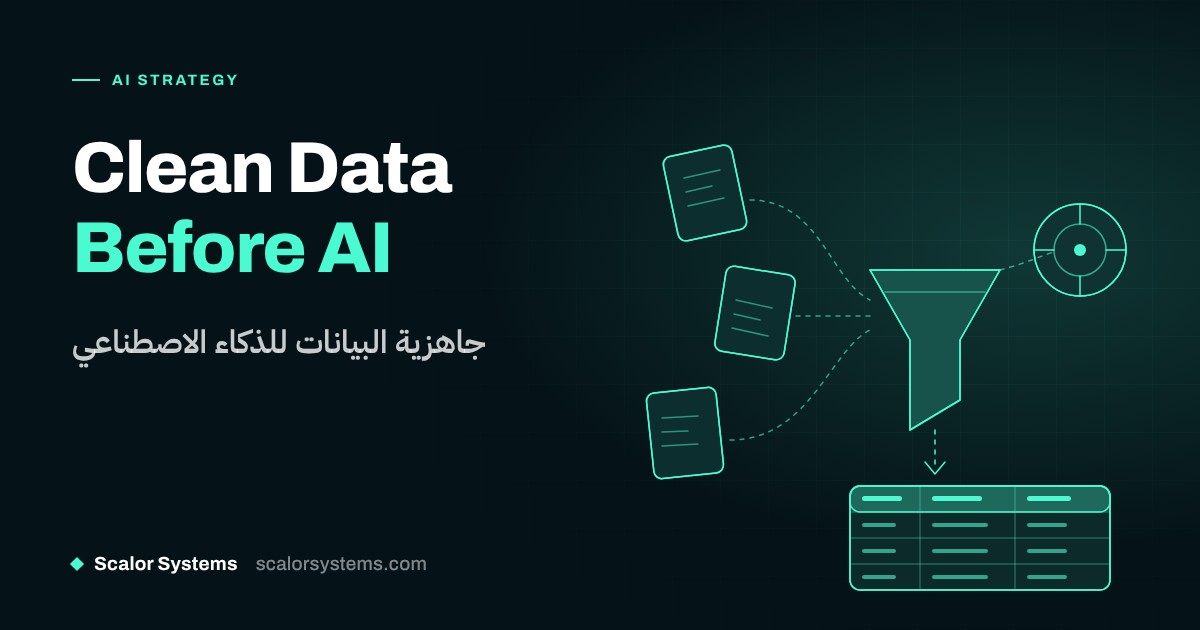
For many firms the messiest data is trapped in documents: delivery notes, contracts, claims, ID copies and invoices. Turning those into structured fields is often the fastest way to create the clean data that later AI work needs. It also gives you a measurable first project, since you can count how many documents were read correctly.
How Scalor Systems can help
Our AI Architecture Audit reviews where your data lives, how clean it is and which use cases it can support today, so you know what to fix before you spend on tools. Our document processing automation solution turns invoices, delivery notes and forms into structured records, and our AI Integration service connects the result to your existing systems. To scope a data readiness review for one use case, book a free discovery call with Scalor Systems at scalorsystems.com/contact.