Saudi Market6 min read
AI Talent Saudi Arabia: What SDAIA’s Study Means for Hiring
Key takeaways
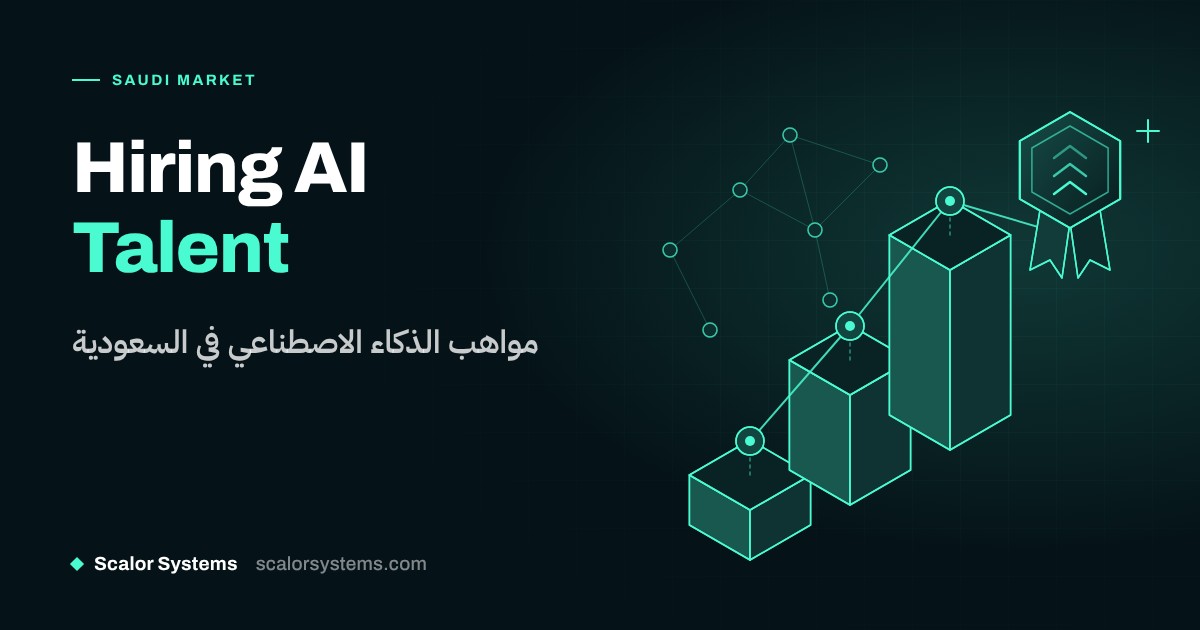
- SDAIA’s new national study, reported on 11 November 2026, ranks Saudi Arabia third in the world for AI talent growth under the 2026 Stanford HAI AI Index, and counts more than 69,300 technical graduates entering the market from 2021 to 2025.
- The ranking measures how fast AI talent is growing, not how many AI specialists exist, so senior people with hands-on experience are still hard to find for a mid-sized company.
- Use SDAIA’s AI professional badges as one signal when you screen candidates, test them on your own data, and decide role by role whether to hire, train or partner.
AI talent in Saudi Arabia is growing faster than almost anywhere else, according to a national study the Saudi Data and AI Authority (SDAIA) released this week. For an owner or manager in Dammam, Khobar, Riyadh or Jeddah, the practical question is narrower: can you find, check and keep the people your own AI projects need? This guide is written for decision-makers, not developers. It covers what the study found, what the rankings do and do not mean, how SDAIA’s new professional badges can help you screen candidates, and six steps for your next hire.
What SDAIA’s study says about AI talent in Saudi Arabia
Riyadh Daily reported on 11 November 2026 that SDAIA had released a comprehensive study on the state of AI in the Kingdom. It reviews progress across seven main pillars and 15 sub-pillars, from regulation and investment to data, human capital, research and adoption.
On people, the study ranks Saudi Arabia third globally for AI talent growth under the 2026 Stanford HAI AI Index. It says more than 69,300 technical graduates entered the market from 2021 to 2025, contributing to a 15% compound annual growth rate in domestic AI talent density. It also reports that 84% of the Saudi public is familiar with AI concepts, and that more than 1.2 million people took part in the first phase of the national SAMAI training initiative by July 2026.
The study also shows how far government has moved. According to the same report, 90% of public entities have an AI strategy, 97% deploy or build AI tools and 77% enforce formal AI governance. Nearly half of adopting entities, 48%, reported internal efficiency gains above 10%.
Read the rankings carefully
When the 2026 Stanford index came out in April, the Saudi Press Agency described the talent ranking more precisely: Saudi Arabia was third for the percentage change in AI talent concentration, and fourth for AI talent attraction. SPA added that the Kingdom recorded the fastest global growth in AI talent share, above 100% between 2019 and 2025.
As the tech site tbreak pointed out, this is a measure of change over time, and Stanford builds its talent data on LinkedIn’s Economic Graph. It does not rank countries by how many AI workers they have. Fast growth from a smaller base is good news, but it does not mean an experienced machine learning engineer is easy to hire in Dammam next month. Plan on the basis that junior and mid-level candidates are becoming easier to find, while senior, hands-on people remain scarce and in demand.
What this means for hiring AI skills at a mid-sized company
Three findings matter most for a company with 50 to 500 staff. These are our interpretations, not conclusions from the study.
- Your current staff may already use AI. SPA reported that, according to the Stanford report, more than 80% of employees in the Kingdom use AI regularly, against a global average of 58%. Before you hire, find out who on your team already uses these tools and how well.
- Government counterparts are being trained. SAMAI 2, launched at ICAN 2026 in January, targets the workforce in 11 ministries, including health, finance, transport and logistics, and municipalities and housing. The officials you deal with will increasingly expect digital, AI-assisted processes.
- The pipeline is mostly early-career. Tens of thousands of new technical graduates are a strong pool for junior roles, provided you have someone senior to guide them and real projects for them to work on.
How to check AI skills: SDAIA’s professional badges
Judging AI skills from a CV is hard for a non-technical manager. On 4 August 2026, SPA reported that SDAIA had opened registration for its AI Professional Badges, first launched at ICAN 2026. This phase covers two specialisations: AI Engineer, focused on practical skills in building AI models and systems, and Data Scientist, focused on algorithm development and analysis.
Applicants go through a standard three-level assessment overseen by an independent scientific committee of researchers, academics and experts from the public and private sectors. SDAIA says the aim is to give sectors a reliable benchmark for identifying highly qualified talent. Registration is through an SDAIA platform, linked in the sources below.
A badge is a useful signal, not a guarantee. Treat it the way you would treat a professional certificate: it tells you the candidate passed a recognised test, and your own practical exercise tells you whether they can do your work.
Hire, train or partner: an AI talent decision guide
Not every AI need justifies a full-time hire. A simple rule of thumb, based on our own experience:
- Train your own people when the work is using AI tools inside existing jobs: drafting, summarising, searching documents, preparing reports. See our guide to AI training for employees in Saudi Arabia.
- Hire when AI becomes a permanent part of how you operate, and you need someone to own data quality, vendor relationships and day-to-day changes.
- Partner when you need senior design and build skills for a defined project, such as an internal knowledge assistant or an integration with your ERP, and want your own staff to take over afterwards.
Six steps for your next AI hire
- Start from the problem, not the job title. Write down the one or two business tasks the person will improve, and how you will measure it.
- Map the skills you already have. A short survey of who uses AI tools today, and for what, often shows an internal candidate.
- Decide the level. A junior analyst needs a senior reviewer, inside or outside the company. Do not hire a single graduate and leave them alone with a critical system.
- Use badges and certificates as a filter, not a verdict. Ask whether candidates hold an SDAIA AI Engineer or Data Scientist badge, and still test them.
- Give a practical test on your own data. A two-hour task with a cleaned, anonymised sample of your invoices, tickets or sales records shows more than any interview.
- Plan for retention. Fast talent growth also means competition for good people. Agree a learning budget, real projects and a clear path before the first offer.
How Scalor Systems can help
Our Custom AI Development service builds AI tools with your team, so your own people learn as the work is done and can run it afterwards. Our AI Integration service connects those tools to the systems you already use, and our AI Knowledge Assistant solution is a practical first project that a small internal team can own. To talk through whether to hire, train or partner for your next AI project, book a free discovery call with Scalor Systems at scalorsystems.com/contact.
Sources
- Riyadh Daily: SDAIA Study: Saudi Arabia Ranks Among Global Top Three in AI Talent Growth and Model Development (11 November 2026)
- Saudi Press Agency: Saudi Arabia Leads World in AI Security, Privacy, Cryptography and Women’s Empowerment: Stanford HAI 2026 Report (14 April 2026)
- Saudi Press Agency: SDAIA Opens Registration for AI Professional Badges (4 August 2026)
- tbreak: Saudi Arabia ranks third in the world for AI talent growth, says SDAIA (11 November 2026)
- Middle East AI News: Saudi Arabia launches SAMAI 2 workforce AI initiative (29 January 2026)
- SDAIA: AI Professional Badges registration page