Saudi Market5 min read
AI Use Policy for Employees Saudi Arabia: 8 Rules
Key takeaways
- The CST Saudi Internet Report 2025, as reported by Arab News, found that 45.2% of Saudi internet users used AI tools, more than double the rate a year earlier. Your staff are very likely using them already, approved or not.
- Microsoft and LinkedIn’s 2024 Work Trend Index found that 78% of AI users bring their own tools to work, which puts company data at risk. SDAIA’s PDPL guidance says pseudonymized data is still personal data, so masking names in a pasted list is not a safe fix.
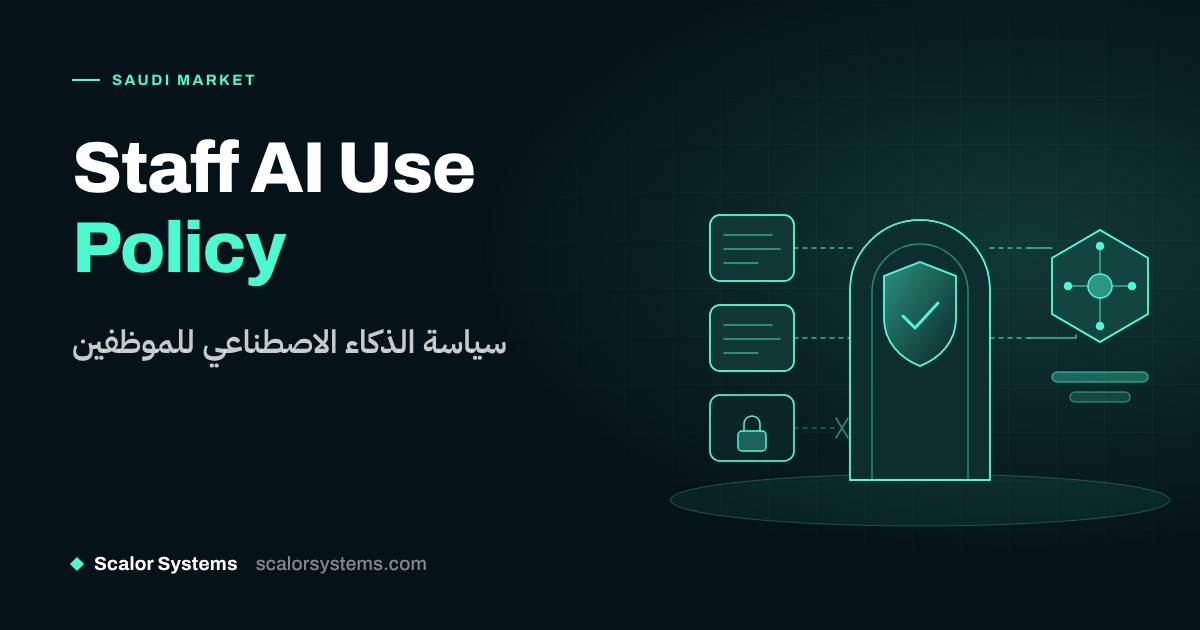
- One page is enough: list approved tools, sort data into green, amber and red, ban personal data in personal accounts, name a person who checks output, and give staff an approved option so they stop reaching for public tools.
An AI use policy for employees in Saudi Arabia is now a practical need, not a paperwork exercise. Your staff are very likely using AI tools already, whether you have approved them or not. This guide is written for owners and managers in Dammam, Khobar, Riyadh and Jeddah in logistics, healthcare, real estate, retail, education and facilities. It shows what the data says about staff use, what the PDPL principles mean when someone pastes a customer list into a chatbot, and eight rules you can put on one page this week.
Your staff are probably already using AI
According to Arab News on 10 August 2026, the Communications, Space and Technology Commission (CST) Saudi Internet Report 2025 found that 45.2% of internet users in the Kingdom used AI tools, more than double the rate recorded the previous year. The same coverage reported that 17.3% used AI for work-related tasks. The coverage does not say whether that share is of all internet users or of AI users, so read it as a direction of travel, not as a count of your own team.
The workplace evidence is global and older. Microsoft and LinkedIn’s 2024 Work Trend Index, based on a survey of 31,000 people in 31 countries and published on 8 May 2024, found that 75% of knowledge workers use AI at work and that 78% of AI users bring their own tools to work. Microsoft calls this “Bring Your Own AI” and says it puts company data at risk. It is not a Saudi survey, but the habit is easy to recognise: people who use AI tools in daily life will use them for work, with or without your permission.
Our reading is that a blanket ban is hard to enforce when the tools sit on every personal phone. A short, clear policy with an approved option usually works better than silence or a ban.
What the PDPL means for what staff paste into AI tools
SDAIA’s guidance for controllers and processors (version 1.0, 2023) sets out the principles behind the Personal Data Protection Law (PDPL). Two matter here. Data minimization means you must not collect more personal data than you need for the purpose. Integrity and confidentiality means you need adequate technical and organizational measures to protect personal data during transmission and storage. The guidance also says a controller must ensure that the processors it engages fully comply with the PDPL.
Now apply that to a normal workday. A clerk pastes a customer list, a nurse’s note, a tenant contract or a student record into a free AI tool to “tidy it up”. Personal data has left your control, and the tool’s provider may be acting as a processor you never checked. Masking the names does not fix this, because SDAIA’s guidance states that pseudonymized data is still considered personal data. This is our practical reading, not legal advice, so check your case with counsel. If the tool is hosted abroad, our guide on PDPL cross-border data transfer and AI explains the extra questions.
Eight rules for an AI use policy for employees in Saudi Arabia
- List the approved tools. Name the AI tools staff may use for work, the jobs they may be used for and who approved them. Anything not on the list needs approval first.
- Sort data into three colours. Green is public information such as published prices. Amber is internal material that only goes into approved tools. Red is customer, patient, tenant, student or employee data, contracts, financial records and passwords, which never goes into an unapproved tool.
- No personal data in personal accounts. Work use goes through company accounts, so you control the settings and can remove access when someone leaves.
- A named person checks the output. Anything sent to a customer, patient or regulator, or used for a money or legal decision, must be read and owned by a human.
- Tell customers when AI is involved. If people chat with an assistant, say so and give them a way to reach a person.
- Check Arabic carefully. Read Arabic text before it goes out, especially names, numbers, dates and legal wording.
- Report mistakes without blame. Give staff a one-line way to report a wrong answer or an accidental paste, so you hear about problems early.
- Review every quarter. Tools and rules change, so revisit the approved list, the data colours and any incidents each quarter.
A two-week rollout checklist
- Days 1 to 3: ask staff, without blame, which AI tools they use and for which tasks.
- Days 4 to 6: pick two or three approved tools and decide what data each may receive.
- Days 7 to 9: write the one-page policy using the eight rules and name an owner.
- Days 10 to 12: brief each team with two real examples of green, amber and red data from their own work.
- Days 13 and 14: set up company accounts, switch off personal-account use for work, and book the first quarterly review.
Give people a safe option, not only a rule
People reach for public tools because they are quick and they answer questions. A policy works best when the approved option does the same job. A private assistant that answers staff questions from your own policies, price lists and procedures, with access controls, removes much of the reason to paste company material into a public chatbot. Our AI knowledge assistant solution is built for this, and it can work in Arabic and English.
How Scalor Systems can help
Our AI Architecture Audit maps which tools your teams use, what data they touch and which first projects are worth doing, so your policy rests on facts. Our AI knowledge assistant solution then gives staff an approved tool, and our AI Integration service connects it to the systems you already run. To talk through a policy for your team, book a free discovery call with Scalor Systems at scalorsystems.com/contact.
Sources
- Arab News, citing the Communications, Space and Technology Commission (CST): Saudi AI tool adoption more than doubles to 45.2% (10 August 2026)
- Zawya (Saudi Gazette), citing the CST Saudi Internet Report 2025: AI adoption more than doubles in Saudi Arabia, reaching 45.2% of internet users
- Microsoft and LinkedIn: 2024 Work Trend Index on the state of AI at work (8 May 2024)
- SDAIA: Guide to the Saudi Personal Data Protection Law for Controllers and Processors, version 1.0 (2023)