Saudi Market5 min read
Engineering Technician Saudization: 35% From May 2027
Key takeaways
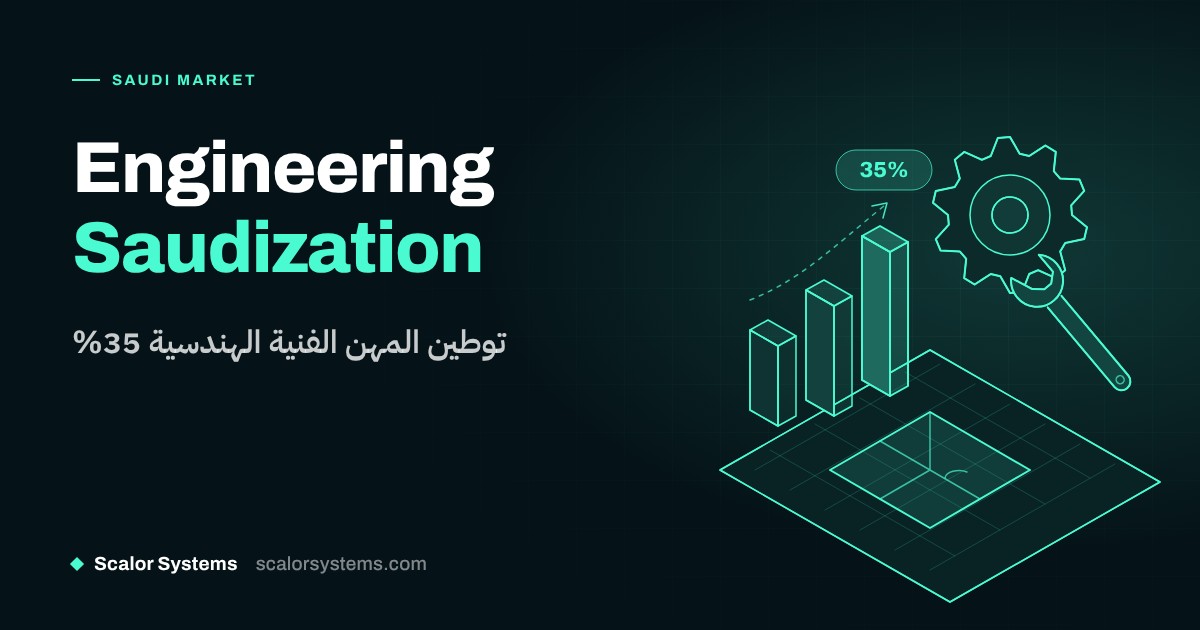
- On 8 November 2026 the Ministry of Human Resources and Social Development, with the Ministry of Municipalities and Housing, raised Saudization for 94 technical engineering professions in the private sector to 35%, effective 9 May 2027.
- The rule covers private establishments with five or more workers in the targeted roles, and the rate is calculated at the level of the whole entity, not branch by branch.
- Under the current HRSD guide, a Saudi technician counts only with a registered GOSI wage of at least SAR 5,000 and Saudi Council of Engineers accreditation, so check job titles, wages and accreditation now.
Engineering technician Saudization is going up. On 8 November 2026, the Ministry of Human Resources and Social Development (HRSD) and the Ministry of Municipalities and Housing announced that the required Saudi share in 94 technical engineering professions rises to 35% in private-sector establishments from 9 May 2027. If you run a facilities, contracting, real estate, logistics or maintenance business in Dammam, Khobar, Riyadh or Jeddah, this touches the people who keep your sites and equipment running. This guide is written for decision-makers, not developers. It covers what changed, how the rate is counted and a six-step plan. It is a business summary, not legal advice.
What the engineering technician Saudization decision says
According to Al Eqtisadiah and Okaz, both reporting on 8 November 2026, the decision raises the Saudization rate for 94 technical engineering professions in private-sector establishments to 35%, starting 9 May 2027. It applies to every private establishment with five or more workers in the targeted professions, and the rate is calculated at the level of the establishment’s entity, as set out in the ministry’s procedural guide.
Named roles include civil, electrical, mechanical and electronics engineering technicians, surveying technicians, mechanical maintenance technicians and architectural draftsmen, plus other technical engineering roles in the Saudi Unified Classification of Occupations. HRSD’s guide page lists a release date of 8 November 2026 and an execution date of 9 May 2027. Okaz reports that covered establishments have a grace period until the start date.
From 30% to 35%: what changes
This is a step up, not a new rule. Under Ministerial Resolution No. 103105 of 26 January 2025, technical engineering professions already carry a 30% Saudization rate, applied from 27 July 2025, according to HRSD’s procedural guide and Gulf News. The new decision lifts that figure by five percentage points.
The guide issued under the January 2025 decision includes many roles outside construction, such as mechanical maintenance technicians, HVAC mechanics, refrigeration mechanics, electrical machine maintenance technicians and electronics device maintenance technicians. Facilities and property companies should not assume this is only a contractor’s problem.
How the Saudization rate is counted
The details below come from the guide HRSD published under the January 2025 decision. The ministry released an updated guide alongside the new rate, so confirm each point against it.
- Entity, not branch. The rate is calculated across all branches of the same economic activity owned by one establishment.
- A wage floor. A Saudi technician counts only if the monthly wage registered with GOSI is at least SAR 5,000.
- Professional accreditation. Technicians must hold accreditation from the Saudi Council of Engineers. Unaccredited technicians do not count.
- Titles and real work. The rule applies to registered job titles and to the work a person actually does. Giving a localised role’s tasks to a non-Saudi under another title, directly or indirectly, triggers Saudization penalties.
- Automatic checks. HRSD monitors compliance through occupational titles in the GOSI database, and checks wages and accreditation through technical links with the supervising bodies.
- The higher rate wins. If another decision targets the same profession at a different rate, the higher rate applies.
A worked example
The current guide gives this example: an entity with 51 technicians, 4 of them Saudi. At 30%, the formula is (51 × 30%) − 4 = 11.3, rounded to 11, so the entity must replace 11 non-Saudi technicians with Saudis during the grace period. Applying the same formula at 35%, which is our own calculation, gives (51 × 35%) − 4 = 13.85, rounded to 14. Five extra points can mean several extra hires for a mid-sized maintenance team.
Saudization compliance plan: six steps before May 2027
- Pull your technician headcount at entity level. Export every employee whose GOSI occupation is a technical engineering role, across all branches of the same activity.
- Match titles to real work. Check that registered titles reflect what each person does on site, and fix any gaps in Qiwa and GOSI before inspectors do.
- Check the two counting conditions. For every Saudi technician, confirm a registered wage of at least SAR 5,000 and valid Saudi Council of Engineers accreditation.
- Calculate your gap at 35%. Use the guide’s formula and round as it does. Model it again if you plan to grow or shrink teams in 2027.
- Plan hiring and training. HRSD says support covers recruitment, training, qualification, employment and job stability, and covered establishments get priority access to Saudization support programmes. Start conversations early, because certified technicians take time to find.
- Name an owner and review monthly. Read the updated procedural guide on HRSD’s website, track progress against the 9 May 2027 deadline and keep evidence of every step.
Where AI and automation help with workforce compliance
Software does not replace your HR adviser, and it cannot hire for you. What it can do is make your position visible early and keep records clean. These are our recommendations, not requirements.
- A Saudization dashboard that combines GOSI occupation codes, wages and accreditation dates into one view of your rate at 30% and 35%, by entity.
- Alerts before accreditation renewals lapse or a wage change drops someone below the counting floor.
- Document reading that pulls titles, wages and dates from contracts and certificates into a single register, with a person checking every result.
- Scenario models that show how many hires you need under different growth plans, before you commit budget.
For the wider payroll picture, see our earlier post, Nitaqat Salary Threshold 2027: SAR 5,000 and What to Do.
How Scalor Systems can help
Our AI dashboards and reporting solution can turn your GOSI, Qiwa and payroll data into a live Saudization view, and our document processing automation solution reads contracts and accreditation certificates into a structured register. Our AI Integration service connects both to the HR systems you already use. To map your own workforce compliance process before May 2027, book a free discovery call with Scalor Systems at scalorsystems.com/contact.
Sources
- Al Eqtisadiah: Saudization of 35% of 94 technical engineering professions in the Saudi private sector (8 November 2026, Arabic)
- Okaz: Saudization rate for 94 technical engineering professions raised to 35% from May (8 November 2026, Arabic)
- HRSD: Procedural Manual for the Saudization Resolution of Technical Engineering Professions (guide page, released 8 November 2026)
- HRSD: Procedural guide for the Saudization decision on technical engineering professions, Ministerial Resolution No. 103105 (PDF, Arabic)
- Gulf News: Saudi Arabia raises Saudization rates across key sectors: dentistry, pharmacy, accounting and engineering (27 January 2025)