Saudi Market5 min read
AI in Saudi Healthcare: What Clinics Should Do in 2026
Key takeaways
- EY’s September 2026 survey found that 69% of Saudi consumers already use AI tools for health information, the highest rate among the 10 countries surveyed.
- The Ministry of Health reports more than 16 million virtual appointments and consultations through Seha Virtual Hospital in 2025, so patients are used to digital care.
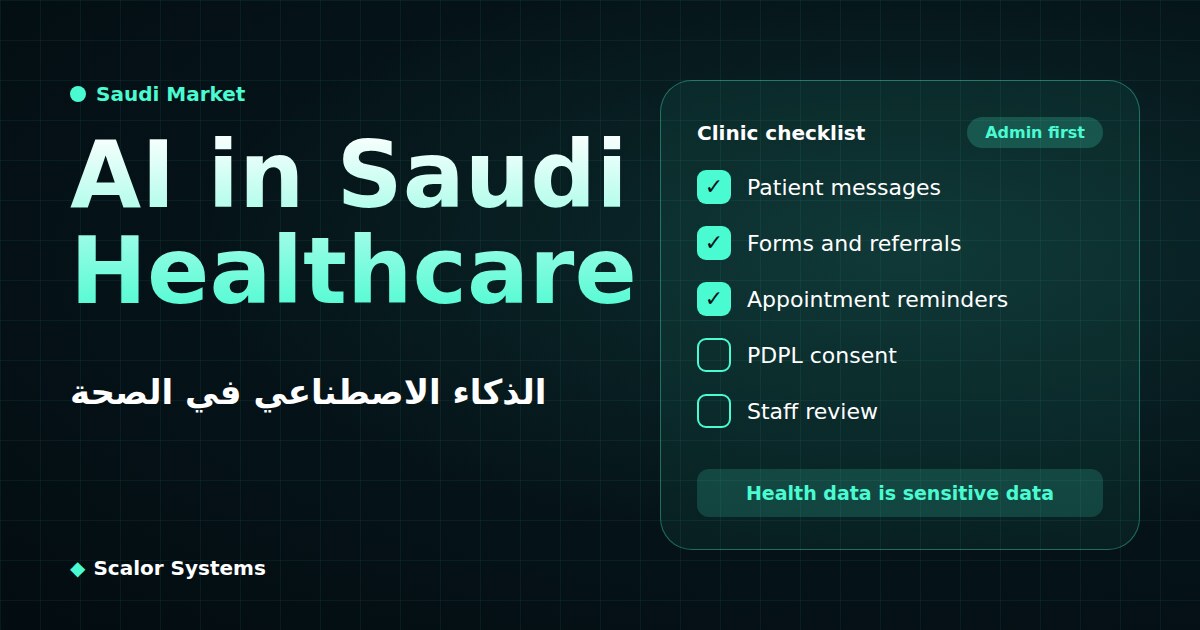
- Health data is sensitive data under the PDPL, so the first AI projects for a clinic should be administrative, with explicit consent and tight access controls.
AI in Saudi healthcare is no longer something patients wait for their provider to introduce. In a September 2026 survey by EY, 69% of Saudi consumers said they already use AI tools to get health information, the highest share of any of the 10 countries surveyed. For owners and managers of clinics, pharmacies, labs and dental groups, that changes what patients expect before they reach the front desk: faster answers, in Arabic and English, at any hour.
What the 2026 data says about AI in Saudi healthcare
EY published its report “Navigating the Future of Health in Saudi Arabia” on 2 September 2026, at LEAP 2026 in Riyadh. It draws on 1,002 Saudi respondents, as part of a global study of nearly 7,700 consumers. Three findings matter most for operators: 75% of Saudi respondents said they are comfortable using AI across the whole patient journey, 88% are willing to share data from wearables and health apps with their providers, and 89% see AI as a complement to clinical expertise, not a replacement for it.
Patients are also used to digital care. On 27 January 2026 the Ministry of Health reported that Seha Virtual Hospital delivered more than 16 million virtual appointments and medical consultations during 2025, including over 11.5 million virtual clinic appointments, a 56% increase on 2024.
The gap between patients and providers
Patients are moving faster than providers. A review published in Cureus in May 2025 looked at 34 major Saudi hospitals and found that only three had implemented AI in patient care, and two had a dedicated AI centre. The review covers large hospitals only and is more than a year old, so treat it as a sign of where provider adoption started, not where it is today. It also names limited training and strict data-confidentiality rules as barriers.
For a smaller clinic, the lesson is practical. You do not need a clinical AI system to improve the patient experience. Much of the daily friction is administrative: unanswered messages, paper forms, missed appointments and reports compiled by hand.
Four places a clinic can start
These are our recommendations for where AI can help with administrative work. They are not findings from the sources above, and none of them involves AI making a diagnosis.
- Patient messages: an AI assistant on WhatsApp or your website answers opening hours, locations, preparation instructions and booking questions in Arabic and English, and hands anything clinical to your staff.
- Forms and documents: AI reads referral letters, insurance forms and lab reports, and fills the fields in your system for a person to check.
- Appointment management: automated reminders and rescheduling, plus a dashboard showing which clinics and time slots have the most gaps.
- Management reporting: one weekly view of waiting times, cancellations and workload, instead of reports assembled by hand from several systems.
PDPL rules for health data and AI
Personal data related to a person’s health is sensitive data under the Personal Data Protection Law, according to SDAIA’s guide for controllers and processors. The guide sets out stricter rules for it. Legitimate interest cannot be your lawful basis, consent must be explicit, and sensitive data cannot be processed for marketing even with consent.
SDAIA’s own example is a pharmacy that infers customers’ health conditions from their purchase history: those inferences count as sensitive data. The same logic applies to an AI tool that learns from patient messages or records. For a plain-language summary of enforcement so far, see our PDPL compliance guide for Saudi businesses.
A six-step checklist before you automate
- List the repeated tasks that take your staff the most hours each week, and choose one that does not involve clinical decisions.
- Record the baseline: messages per day, response time, no-show rate and hours spent on forms.
- Map the patient data the task touches and where it is stored, and confirm you have a lawful basis and explicit consent where it is needed.
- Ask any AI vendor where data is hosted, who can access it and whether it is used to train their models.
- Keep a person in the loop: define which messages and documents staff must review, and how a patient reaches a human.
- Pilot with one clinic or team for four to eight weeks against one agreed measure before you expand.
Most clinics find the first project is mainly an integration task: the AI has to work with your booking system, your patient records and WhatsApp. An AI Architecture Audit maps those systems and ranks the opportunities by return and risk. For the patient-facing step, AI customer service agents are the usual starting point, and document processing automation covers forms and referrals.
Where to start
Pick one administrative process, measure it, and check the data rules before you choose a tool. When you are ready to test it, book a free discovery call with Scalor Systems at scalorsystems.com/contact.
Sources
- EY MENA: Saudi Arabia is outpacing global peers in AI and digital health adoption, says EY MENA’s new report launched at LEAP 2026 (2 September 2026)
- Saudi Ministry of Health: Over 16 Million Appointments in 2025 Drive Seha Virtual Health Care Up (27 January 2026)
- SDAIA: Guide to the Saudi Personal Data Protection Law for Controllers and Processors, version 1.0 (December 2023)
- Bayer and Eisawi, Cureus: Exploring the Landscape of Artificial Intelligence in Saudi Arabia’s Healthcare Sector: Current Trends and Challenges (15 May 2025)