Saudi Market5 min read
AI Adoption in Saudi Arabia: 2025 Data by Sector
Key takeaways
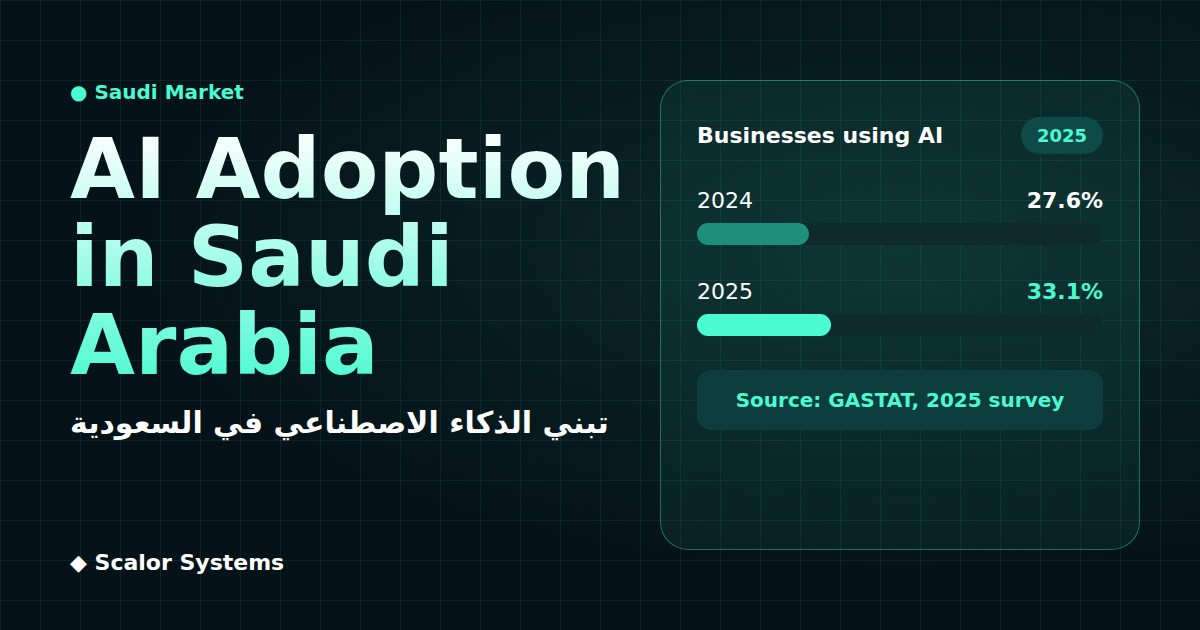
- GASTAT reports that 33.1% of Saudi establishments used AI in 2025, up from 27.6% in 2024.
- Transport and storage (44.4%) and education (51.0%) lead the sectors our readers work in. Retail (30.2%), real estate (31.8%) and health (35.6%) sit near or just above the national average.
- With a third of businesses already using AI, the question for owners is no longer whether to start but which one process to automate first.
AI adoption in Saudi Arabia is now measured, not guessed. The General Authority for Statistics (GASTAT) reports that 33.1% of establishments in the Kingdom used artificial intelligence technologies in 2025, up from 27.6% a year earlier. For owners and managers in logistics, healthcare, retail, real estate and education, that means roughly one in three businesses already has AI somewhere in its operations, and the rest are choosing whether to follow.
What the official numbers say about AI adoption in Saudi Arabia
The figures come from GASTAT’s Establishments ICT Access and Usage Statistics 2025, published in June 2026. The share of establishments using AI rose 20.0% compared with 2024. That is relative growth: from 27.6% to 33.1% of establishments, according to GASTAT’s 2024 and 2025 releases.
The foundations are strong. GASTAT found that 98.1% of establishments have internet access, 79.1% use online banking and 51.3% use cloud computing. AI is being added to businesses that are already digital.
AI adoption by sector: where your industry stands
Adoption varies widely by industry. Here are the sectors most relevant to Saudi SMEs, with GASTAT’s 2025 figure beside the 2024 figure reported by Arab News from GASTAT’s previous release:
| Sector | 2024 | 2025 |
|---|---|---|
| Information and communication | 52.8% | 61.1% |
| Financial and insurance | 44.7% | 52.9% |
| Education | 42.1% | 51.0% |
| Transportation and storage | 38.3% | 44.4% |
| Human health and social work | 29.9% | 35.6% |
| Real estate | 28.2% | 31.8% |
| Wholesale and retail trade | 25.0% | 30.2% |
Logistics operators (transport and storage) and educators are well ahead of the average. Healthcare, real estate and retail are close to it, which means the gap is still small. Every sector in the table grew in a single year.
What AI adoption in Saudi Arabia means for smaller firms
GASTAT’s release does not break adoption down by company size, so we cannot say how many smaller firms are included. What it does show is that a third of establishments across the economy are already past the first experiment, and retail and real estate sit only a few points above the line.
Early users also report results. In a survey of Saudi chief IT decision-makers commissioned by SAP and run by YouGov in 2026, 50% said their AI initiatives were exceeding expectations and 41% said they were meeting them. The survey also found that 54% are upskilling or reskilling employees at scale and 59% invest in AI strategically across the enterprise. SAP does not publish the sample size, so read it as a signal from larger IT teams rather than a benchmark for every SME.
How to read these numbers
Three cautions help you use the data well. First, GASTAT counts an establishment as an AI user if it uses AI technologies at all, so a company using one chatbot and a company running AI across its operations both count. Second, a sector average hides large differences between firms. Third, adoption is not the same as value: the useful measure is hours saved, errors avoided or revenue protected in your own business.
Treat the sector figure as a competitive reference. If your direct competitors are in the third that already use AI, they may be answering customers faster or closing their books sooner than you.
A five-step plan to join the one in three
- Pick one process, not a platform: choose a repeated task with clear volume, such as answering WhatsApp enquiries, reading invoices or compiling a weekly report.
- Measure the baseline: record hours spent, error rates and cost per transaction before anything is automated.
- Check your data: confirm the information the process needs is accessible and that you have a lawful basis for using it under the PDPL.
- Run a small pilot: aim for four to eight weeks, one team and one success metric agreed in advance.
- Train the people who will use it: decide who owns the tool, who reviews its output and when a human takes over.
Most of the cost in a first project comes from a poorly chosen use case, not from the technology. If you are unsure where to begin, an AI Architecture Audit maps your processes and systems and ranks the opportunities by return. For a customer-facing first step, AI customer service agents and AI dashboards and reporting are common starting points for Saudi SMEs.
Where to start
Look up your sector in the table, then ask which single process costs your team the most hours each week. That is your first candidate. When you are ready to test it, book a free discovery call with Scalor Systems at scalorsystems.com/contact.
Sources
- General Authority for Statistics (GASTAT): Establishments ICT Access and Usage Statistics 2025 (June 2026)
- Arab News: Saudi AI adoption among businesses rises to 33% in 2025: GASTAT (14 June 2026)
- Arab News: Saudi businesses step up AI use as adoption reaches 27.6%: GASTAT (28 December 2025)
- SAP MENA: Saudi Businesses See Strong AI Returns as Workforce Transformation Accelerates, SAP Survey Finds (24 June 2026)