AI Engineering5 min read
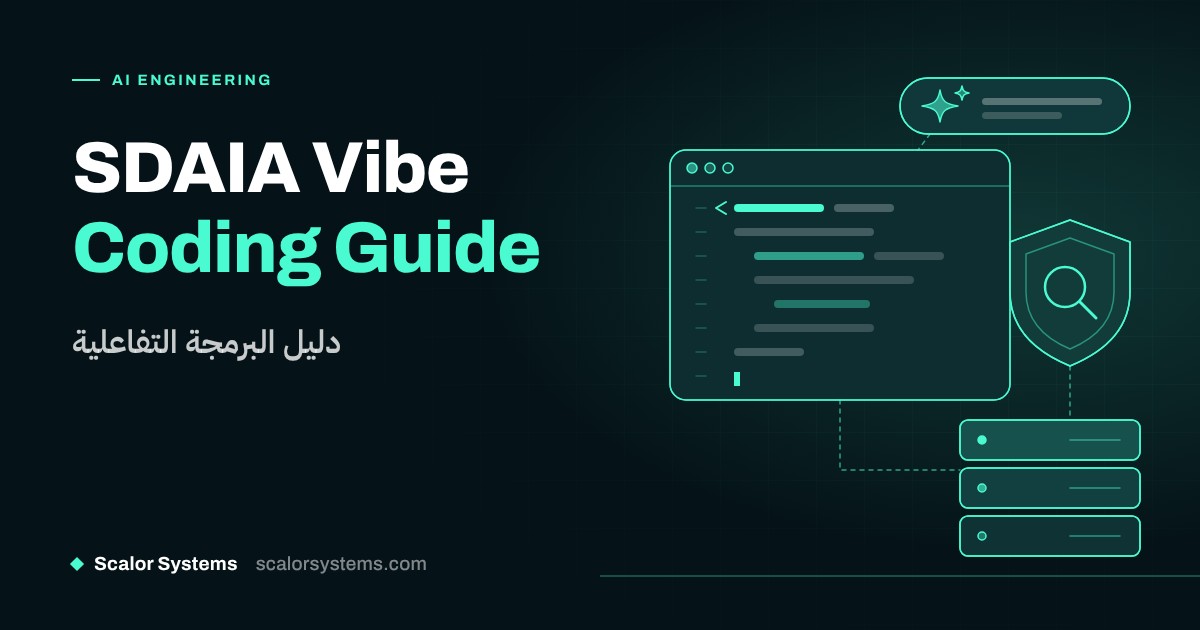
SDAIA Vibe Coding Guide: What Business Owners Should Do
Key takeaways
- On 29 October 2026 SDAIA issued a vibe coding guide, a national reference on using generative and agentic AI tools to plan, write, review and test software.
- The guide keeps people in charge: developers must direct the tools, review their output and verify quality before anything goes live.
- Independent testing shows why. Veracode found AI models introduced security flaws in 45 percent of its coding tasks, so set review rules before your team ships AI-written code.
The SDAIA vibe coding guide is Saudi Arabia’s first national reference on building software with AI tools. If your developers, your IT contractor or an ambitious analyst already use AI to write code, it tells you what good practice looks like. This post is written for owners and managers of small and mid-sized companies in Dammam, Khobar, Riyadh and Jeddah, not for developers. It covers what the guide says, why AI-written code needs checking, and seven controls to put in place before AI-built tools reach your customers or your data.
What the SDAIA vibe coding guide says
“Vibe coding” is the informal name for describing what you want in plain language and letting an AI tool write the code. On 29 October 2026 the Saudi Press Agency reported that the Saudi Data and AI Authority (SDAIA) had issued a guide to vibe coding as a strategic national reference for developers and specialists. The guide is published in Arabic on SDAIA’s website.
According to SPA, the guide covers the use of generative and agentic AI tools across the whole development process: generating ideas, building prototypes, writing, analysing and improving code, and preparing and automating test cases and analysing their results. Its stated aims are higher productivity together with high standards of reliability, quality and cybersecurity.
SDAIA links the guide to Saudi Arabia’s Year of Artificial Intelligence 2026 and to Vision 2030. The Technology Express described it as a reference for technical professionals with recommendations for both government and private-sector organisations. It is guidance, and the coverage we read does not describe it as a binding regulation.
Three principles every manager should know
- People stay responsible. The guide says AI does not reduce the central role of human expertise. Developers must direct the tools, oversee their work, review the output and verify its quality before approving it or putting it into operation.
- Prompts need structure. The guide recommends writing prompts with a clear role, context, instructions, input data, constraints and output format, to improve accuracy and reduce unreliable results.
- Risks are real. The guide names inaccurate results and reliability and security problems, and calls for technical and professional safeguards.
Why AI-generated code needs a security review
The guide’s caution is backed by independent testing. In its 2025 GenAI Code Security Report, published on 30 July 2025, Veracode tested more than 100 large language models on 80 coding tasks. It found that AI-generated code introduced security vulnerabilities in 45 percent of cases. When a model could choose between a secure and an insecure way to write the code, it chose the insecure way 45 percent of the time. Java was the riskiest language tested, with a security failure rate above 70 percent.
These are lab results on set tasks, not a measure of your own systems. But the lesson for a business owner is simple: code that runs is not the same as code that is safe. A tool that reads customer records, posts invoices or connects to your ERP deserves the same review whether a person or a model wrote it.
Where AI coding tools help a mid-sized company
Used well, AI coding tools can shorten the time it takes to build small internal tools. In our experience the safest early uses are the ones with limited reach. These are our suggestions, not part of the guide.
- Prototypes. A clickable mock-up of a booking screen or a delivery tracker, shown to users before anyone commits budget.
- Internal reports. Scripts that pull sales, stock or maintenance data into a weekly summary for managers.
- Test cases. Drafting tests for existing systems, which the guide itself lists as a use.
- Documentation. Explaining what old code does, so the next developer is not starting from zero.
Be more careful with anything that touches personal data, payments, tax records or customer-facing channels. Those systems also fall under other rules, such as the Personal Data Protection Law and ZATCA e-invoicing requirements.
Seven controls before AI-written code goes live
- Write down which AI coding tools are allowed, and who may use them. Unapproved tools are hard to govern.
- Keep secrets out of prompts. No passwords, API keys, customer records or contract details pasted into a public AI tool.
- Use the guide’s prompt structure. Ask your team to state the role, context, instructions, inputs, constraints and expected output, and to keep important prompts with the code.
- Require human code review. Name a developer who reads and approves every AI-written change before it is merged.
- Scan and test. Run automated security scanning and tests on every change, and treat a failed scan as a stop sign.
- Separate test from live. Build and try AI-written tools on copies of data, never directly on production systems.
- Assign an owner. Every tool in use needs one person who answers for it, keeps it updated and switches it off when it is no longer needed.
Questions to ask your developers or vendor
If an outside firm builds software for you, ask whether they use AI coding tools, which ones, and where your code and data go when they do. Ask how AI-written code is reviewed, which security scans run before release, and whether they have read the SDAIA vibe coding guide. A good partner will answer clearly. For a wider view of AI security controls, see our earlier post, AI Cybersecurity Guidelines Saudi Arabia: What to Do.
How Scalor Systems can help
Our AI Architecture Audit service reviews how AI tools are already used in your software and data, including AI-written code, and gives you a prioritised list of fixes. Our Custom AI Development service builds new tools with human review and security testing at every step, and our AI dashboards and reporting solution is a practical first project for teams that want quick internal wins. To talk through your own setup, book a free discovery call with Scalor Systems at scalorsystems.com/contact.
Sources
- Saudi Press Agency: SDAIA Issues Vibe Coding Guide for Efficient, Secure AI-Powered Software Development (29 October 2026)
- SDAIA: Vibe Coding guide (PDF, in Arabic)
- Riyadh Daily: SDAIA Issues Vibe Coding Guide for Efficient, Secure AI-Powered Software Development (29 October 2026)
- The Technology Express: SDAIA Releases Guide to AI-Powered Vibe Coding (31 October 2026)
- Veracode: AI-Generated Code Poses Major Security Risks in Nearly Half of All Development Tasks (30 July 2025)